You spent weeks mastering Java loops, debugging complex Python code, and perfecting your SQL queries. You sat through technical assessments for companies like Infosys or Cognizant, and you finally cleared the coding interview. You feel invincible. Then comes the final hurdle: the HR round.
Many freshers treat the HR interview as a mere formality, assuming that passing the technical rounds means the job is already in the bag. This is a massive misconception. The HR round is where companies evaluate your communication skills, cultural fit, stability, and behavioral traits. A single red flag here can instantly tank your chances, leaving you wondering where things went wrong.
Let’s break down exactly what happens in these sessions, explore the core reasons behind why candidates stumble, and walk through actionable strategies to ensure your final interview ends with a job offer.
2. Quick Summary Box
| Feature | Detail |
| Best For | College freshers, BCA/BTech/MCA graduates, and entry-level job seekers |
| Cost | Completely Free Strategy |
| Difficulty Level | Beginner to Intermediate |
| Key Benefits | Boosts interview confidence, prevents cultural fit rejection, and improves salary negotiation outcomes |
3. What Is the HR Interview Round?
- 2. Quick Summary Box
- 3. What Is the HR Interview Round?
- 4. Why Companies Conduct HR Rounds
- 5. Key Elements Judged in an HR Interview
- 6. How the HR Evaluation System Works
- 7. Practical Scenario: The Technical Ace vs. The Cultural Fit
- 8. Step-by-Step Guide to Mastering the HR Round
- 9. Benefits of Proper HR Preparation
- 10. Limitations of Relying Solely on Rote Memorization
- 11. Pros and Cons Matrix of Common HR Strategies
- 12. Deep Dive: Common Mistakes Freshers Make in HR Rounds and How to Avoid Them
- 13. Frequently Asked Questions
- Q1. Is the HR round just a formality?
- Q2. How should I answer questions about long-term career goals?
- Q3. What if I don’t know the answer to a situational HR question?
- Q4. How do I handle questions about working night shifts or relocation?
- Q5. Can a poor HR round ruin a perfect technical score?
- Q6. How should I dress for a virtual HR interview?
- Q7. How do I explain gaps in my academic years?
- Q8. Is it okay to ask about salary structure in the HR round?
- Q9. How do I show that I am a good team player?
- Q10. What is the biggest red flag for an HR interviewer?
- 14. Final Thoughts
- SEO Optimization Data
The Human Resources (HR) round is the final evaluating phase of a corporate recruitment pipeline. Unlike technical interviews that test what you know, the HR interview focuses on who you are.
HR professionals look at your personality, behavioral patterns, problem-solving mindset, and long-term career goals. They want to ensure that you are easy to work with, adaptable to shifting project requirements, and likely to stick around for more than a few months. For a fresher, this round translates your academic background and technical projects into human value.
4. Why Companies Conduct HR Rounds
Companies invest significant time and money into onboarding fresh graduates. If an employee leaves within six months or creates friction within a development team, the company loses that investment.
HR managers use this round to filter out candidates who look great on paper but lack the soft skills required to thrive in a professional environment. They assess your alignment with corporate values, your ability to handle constructive criticism, and your willingness to learn new technologies under tight project deadlines.
5. Key Elements Judged in an HR Interview
When you sit across from an HR manager, they are implicitly scoring you on several foundational traits:
- Communication Skills: Can you explain complex thoughts clearly without rambling?
- Cultural Fit: Will you blend seamlessly into their existing engineering or development teams?
- Emotional Intelligence (EQ): How do you handle failure, conflicts, or stressful scenarios?
- Stability & Commitment: Are you using this job as a temporary stepping stone, or do you want to build a career here?
- Professionalism: Your body language, punctuality, and overall demeanor.
6. How the HR Evaluation System Works
The evaluation process typically follows a structured behavioral assessment model. HR interviewers often use situational questions designed to trigger spontaneous, honest responses rather than rehearsed answers.
[Candidate Response] ➔ [HR Maps to Core Competency] ➔ [Evaluates Long-Term Risk/Fit] ➔ [Final Hiring Decision]
They score your answers against a matrix of company values. For example, if a company highly values continuous learning, answering an HR question with an attitude that implies you know everything can result in a low score, regardless of your technical performance.
7. Practical Scenario: The Technical Ace vs. The Cultural Fit
Consider two freshers applying for an Android developer role:
- Candidate A: Scored 100% on the coding test, built three complex personal apps, but during the HR round, appeared arrogant, gave one-word answers, and showed zero knowledge about the company’s products.
- Candidate B: Scored 80% on the coding test, built two standard projects, but was highly articulate, demonstrated deep research about the company, and showed a strong eagerness to learn new backend tools.
In a vast majority of cases, the company will hire Candidate B. Technical skills can be taught via training modules, but a poor attitude or bad communication is incredibly difficult to fix.
8. Step-by-Step Guide to Mastering the HR Round
Navigating this round successfully requires deliberate preparation. Follow these steps to build a solid foundation before your interview day.
Step 1: Research the Company Thoroughly
Do not limit your research to the company’s homepage. Read their recent press releases, check their corporate blog, understand their core services, and look up their leadership team on LinkedIn.
Step 2: Prepare for Behavioral Questions Using the STAR Technique
When asked about challenges or projects, structure your answer using the STAR method:
- Situation: Set the scene or context.
- Task: Explain the challenge or goal you needed to address.
- Action: Detail the specific steps you took to resolve it.
Step 3: Align Your Resume with Your Narrative
Every project, internship, or certification listed on your resume is fair game. Ensure you can explain the practical utility of your college projects without stumbling or contradicting your written details.
Step 4: Practice Mock Interviews
Record yourself answering common questions or practice with a peer. Pay close attention to your pacing, filler words (like “um” and “basically”), and facial expressions.
9. Benefits of Proper HR Preparation
| Advantage | Practical Outcome |
| Reduced Anxiety | Knowing how to structure answers keeps you calm under pressure. |
| Higher Offer Conversion | Closing the loop with a strong HR performance ensures the offer letter is generated. |
| Better Negotiation Leverage | Demonstrating high professional value can position you better during salary discussions. |
10. Limitations of Relying Solely on Rote Memorization
While preparation is key, memorizing exact scripts is highly risky. Experienced HR professionals can instantly spot a rehearsed, robotic response. If they throw a curveball question that breaks your memorized script, you might freeze up. Focus on memorizing talking points and structures rather than exact, word-for-word sentences.
11. Pros and Cons Matrix of Common HR Strategies
| Strategy | Pros | Cons |
| Using Rehearsed Scripts | Ensures no grammatical mistakes; covers all technical points. | Sounds robotic; fails if the interviewer interrupts or changes track. |
| Pure Spontaneous Answering | Sounds highly authentic, genuine, and conversational. | Risk of rambling, losing track of the question, or missing key achievements. |
| Structured Framework (STAR) | Keeps answers concise, punchy, and results-oriented. | Requires upfront practice to execute naturally without sounding rigid. |
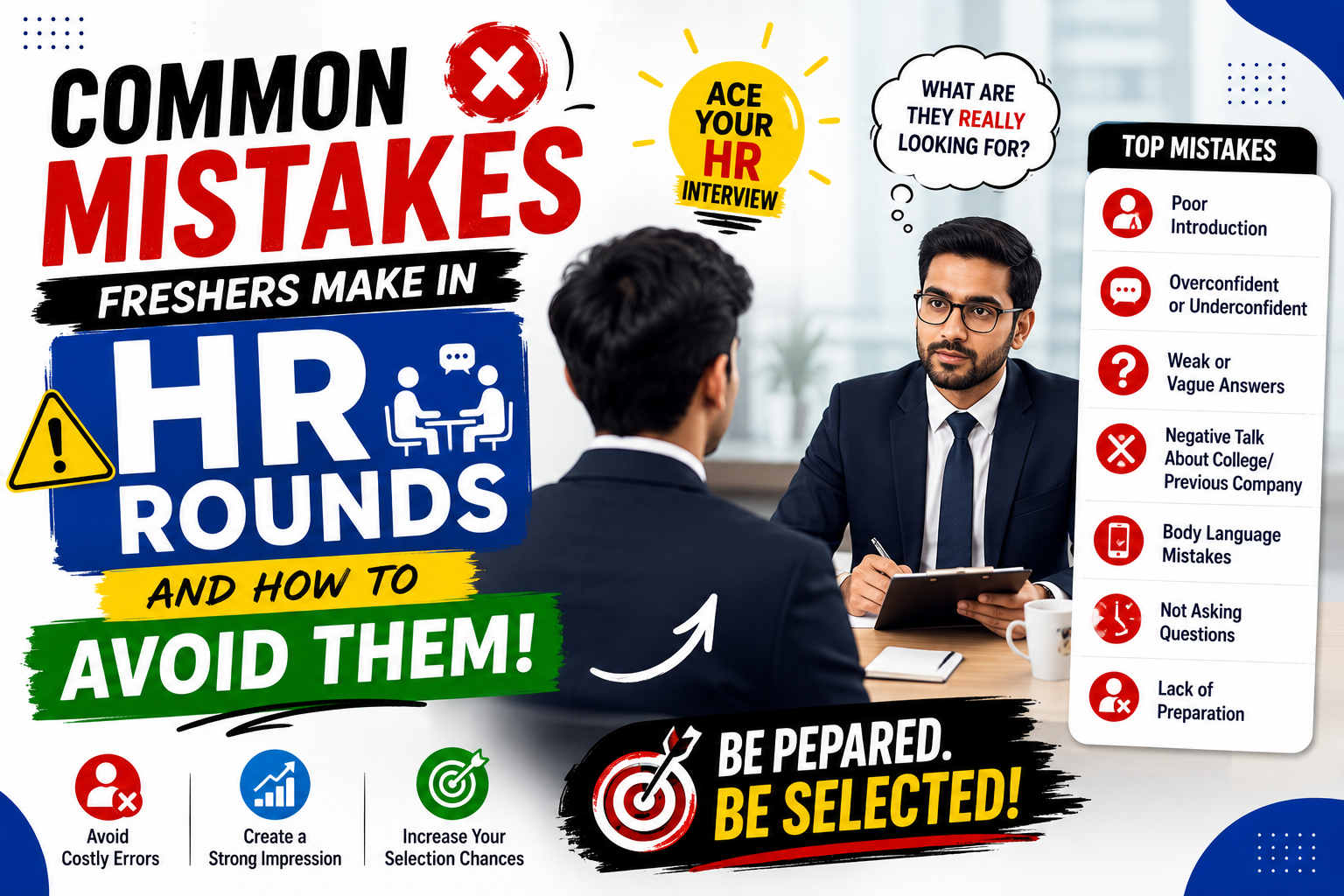
12. Deep Dive: Common Mistakes Freshers Make in HR Rounds and How to Avoid Them
Let’s dissect the core issues that trip up fresh graduates and look at practical ways to fix them before your next interview.
1. The “Tell Me About Yourself” Ramble
Many freshers treat this icebreaker question as a verbal reading of their resume. They spend five minutes detailing their high school percentages, family background, and hobbies, completely losing the interviewer’s attention.
- How to avoid it: Keep it to 60-90 seconds. Focus on a brief academic overview, highlight 1 or 2 key technical projects or internships, mention your core programming strengths, and conclude with why you are excited about this specific role.
2. Utter Lack of Company Research
When an HR manager asks, “What do you know about our company?” and a candidate responds with, “You are a top MNC and great for freshers,” it reveals a complete lack of effort.
- How to avoid it: Mention specific details. For instance: “I noticed your recent shift toward cloud migration services for banking clients, which aligns perfectly with the cloud computing electives I took in my final year.”
3. Bad-Mouth or Dismiss Your College or Peers
When asked about a time a group project went wrong, freshers often blame their team members entirely to make themselves look good. This signals a lack of teamwork and low emotional intelligence.
- How to avoid it: Take accountability. Focus on how you resolved the communication gap or technical bottleneck to get the project back on track, rather than pointing fingers at college peers.
4. Giving Cliché Weaknesses
Saying “I am a perfectionist” or “I work too hard” sounds disingenuous. HR interviewers have heard these phrases hundreds of times and view them as an evasion tactic.
- How to avoid it: State a genuine, non-fatal professional weakness and immediately follow it up with how you are actively fixing it. For example: “I used to struggle with managing public presentations, so I recently joined a college club to practice speaking in front of larger groups.”
5. Saying “No” When Asked if You Have Questions
At the end of the round, the interviewer will almost always ask, “Do you have any questions for me?” Saying no signals a lack of curiosity and passive interest in the opportunity.
- How to avoid it: Ask insightful questions about the team structure, the onboarding training path, or upcoming company milestones.
13. Frequently Asked Questions
Q1. Is the HR round just a formality?
Absolutely not. It is a critical elimination round where your communication, attitude, stability, and cultural alignment are formally evaluated.
Q2. How should I answer questions about long-term career goals?
Focus on growth and skill acquisition. Avoid stating that you want to switch fields or go for higher studies in a year, as companies want to hire long-term talent.
Q3. What if I don’t know the answer to a situational HR question?
Take a moment to think. You can say, “That’s an interesting scenario. Let me think for a moment how I would handle that,” instead of blurting out an unorganized answer.
Q4. How do I handle questions about working night shifts or relocation?
Be honest but flexible. If you are open to it, state your willingness clearly. If you have severe constraints, it is better to discuss them early rather than backing out after receiving the offer.
Q5. Can a poor HR round ruin a perfect technical score?
Yes. If the HR manager flags you for poor communication, behavioral issues, or low commitment risk, the company will likely pass on your application.
Q6. How should I dress for a virtual HR interview?
Treat it exactly like an in-person interview. Wear professional attire, ensure your background is clean and quiet, and maintain good eye contact with the camera.
Q7. How do I explain gaps in my academic years?
Be honest and direct. Whether it was due to health issues, financial constraints, or preparing for competitive exams, explain what you learned or how you upskilled during that period.
Q8. Is it okay to ask about salary structure in the HR round?
Yes, but let the HR interviewer bring it up first. When they discuss compensation, you can ask for clarifications regarding fixed pay, variables, and allowances.
Q9. How do I show that I am a good team player?
Use examples from your college projects, tech fests, or sports activities where you collaborated with others to solve a problem or achieve a shared goal.
Q10. What is the biggest red flag for an HR interviewer?
Arrogance, dishonesty about resume details, and showing absolute indifference toward the company’s domain or values.
14. Final Thoughts
The HR round is your final pitch to prove you are a dependable, proactive professional ready to join a corporate environment. By avoiding standard pitfalls—like unstructured self-introductions, generic answers, and a lack of company research—you set yourself apart from the massive pool of entry-level applicants. Approach the conversation with honesty, structure your examples clearly, and treat the interviewer as a future colleague.
SEO Optimization Data
Internal Linking Opportunities
- Context: Preparing for aptitude tests. Anchor Text: Cognizant recruitment aptitude assessment preparation guides
- Context: Building strong programming foundations. Anchor Text: essential SQL database concepts for interviews
- Context: Formatting entry-level engineering profiles. Anchor Text: resume building strategies for freshers
- Context: Developing software projects. Anchor Text: how to present Java and Python projects on your resume
- Context: Tackling technical interviews. Anchor Text: cracking technical rounds for top tech MNCs
Authoritative External References
- Harvard Business Review: Best practices for structuring behavioral interview responses.
- Society for Human Resource Management (SHRM): Entry-level hiring trends and cultural fit metrics.
- NACE (National Association of Colleges and Employers): Top soft skills employers look for in college graduates.