| Feature | Details |
| Best For | Final-year engineering, BCA, and MCA students aiming for Systems Engineer (SE) or Digital Specialist Engineer (DSE) roles. |
| Price / Access | Completely Free (Based on open-source community sharing). |
| Difficulty Level | Beginner to Intermediate (Focuses heavily on fundamental clarity). |
| Key Benefits | Practical insights into frequently asked coding questions, core CS theory, and behavioral parameters expected by HR panels. |
What Is the Infosys Freshers Interview Process?
- What Is the Infosys Freshers Interview Process?
- Key Features of a Standard Infosys Interview
- How the Technical and HR Rounds Work
- Practical Insights from Selected Candidates
- Step-by-Step Preparation Guide
- Benefits of Following a Foundational Preparation Strategy
- Limitations of Relying Solely on Past Interview Experiences
- Interview Assessment Breakdown
- Common Pitfalls to Avoid During Preparation
- Frequently Asked Questions
- 1. What programming languages should a fresher prioritize for the technical interview?
- 2. How deep should my knowledge of Data Structures and Algorithms (DSA) be?
- 3. What is the most reliable way to explain the four core pillars of OOPs?
- 4. Can non-computer science students clear the technical interview?
- 5. How should I respond if I do not know the answer to a technical question?
- 6. What standard SQL questions are asked of freshers?
- 7. Why does the HR panel ask about working in night shifts?
- 8. How long does it take to receive results after the final HR round?
- 9. What are the key criteria evaluated during the project review section?
- 10. Is the Infosys technical interview tough compared to product companies?
The Infosys recruitment drive for freshers typically filters candidates through a multi-stage process. It begins with a comprehensive, proctored online evaluation that tests quantitative aptitude, logical reasoning, pseudo-code analysis, visual puzzles, and English grammar.
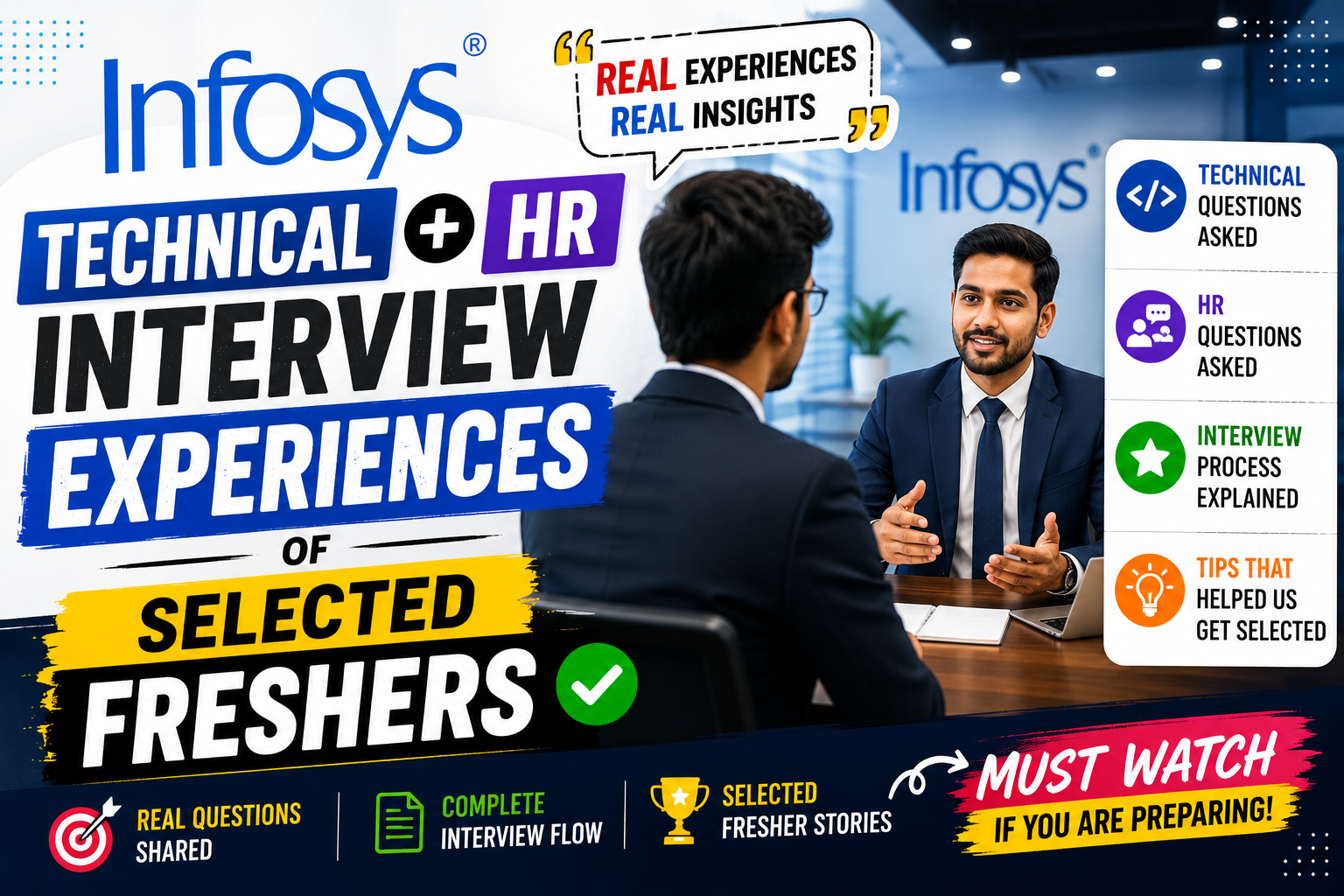
Candidates who achieve the cut-off score move forward to the interview phase. Depending on the specific hiring drive, this can consist of a combined technical-plus-HR round or two separate evaluation blocks: a core Technical Interview followed by a behavioral HR interview. The entire architecture of this process focuses on assessing how reliably you understand fundamental programming concepts and how flexibly you communicate under professional constraints.
Why People Analyze Past Interview Experiences
Preparing for campus placements without looking at recent interview patterns is like walking into a maze without a map. Freshers review compiled interview experiences for three practical reasons:
- Pattern Recognition: IT companies tend to rotate specific types of conceptual questions. Knowing whether a panel leans towards string manipulation programs or object-oriented programming (OOP) architecture helps prioritize your revision time.
- Anxiety Reduction: Familiarity breeds confidence. Knowing the exact sequence of events—from the “Introduce yourself” opener to the final puzzle challenge—lowers stress levels.
- Strategic Optimization: A student preparing for placement drives may spend hours trying to learn advanced, complex systems architecture. Reviewing real feedback reveals that Infosys panels prioritize rock-solid clarity on elementary programming concepts over half-baked knowledge of advanced frameworks.
Key Features of a Standard Infosys Interview
Understanding the core components of the discussion allows you to prepare modules systematically:
- Resume Validation: The panel will systematically go through your listed projects, internships, and programming languages.
- Database Management Core: Expect structured questions testing your ability to write joins, differentiate keys, and explain normalization steps.
- Behavioral Assessment: The final check focuses on structural flexibility, willingness to work night shifts, relocation choices, and corporate alignment.
How the Technical and HR Rounds Work
The evaluation architecture operates on a progressive filtering mechanism:
[Online Assessment] ──> [Technical Interview (30-45 Mins)] ──> [HR Interview (15 Mins)]
During the technical round, the evaluator aims to find the limits of your foundational computing knowledge. They will ask you to explain concepts using real-life examples rather than textbook definitions. Once cleared, the HR round acts as a corporate alignment validator. Here, the focus shifts entirely to your verbal clarity, cultural adaptability, and baseline professionalism.
Practical Insights from Selected Candidates
Consider the experience of a final-year student who went through the off-campus hiring drive. Their interview began directly with an explanation of their capstone project. Instead of asking for complex syntax, the interviewer focused heavily on database relationships.
This highlights a common theme: panels care deeply about the internal logic of your thoughts. If you write a block of code that has a minor syntax error but your structural logic is clean and you explain your debugging steps clearly, you stand a high chance of passing.
Step-by-Step Preparation Guide
To prepare effectively for the Technical and HR phases, follow this structured plan:
Step 1: Polish the Fundamentals
Spend three to four days solidifying your understanding of OOPs principles (Abstraction, Encapsulation, Inheritance, and Polymorphism). Be ready with a real-world analogy for each one.
Step 2: Master Common Array and String Programs
Practice basic array rotations, palindrome checks, string reversals, and Fibonacci sequence generation. Write them cleanly without relying on integrated development environment (IDE) auto-completers.
Step 3: Decode Your Own Resume
Review every line of your project descriptions. If you mention “SQL,” you must be ready to write nested queries on a digital whiteboard.
Step 4: Structure Your Behavioral Answers
Use the STAR method (Situation, Task, Action, Result) to answer behavioral questions. Prepare clear narratives regarding how you handled a conflict or managed a tight project deadline.
Benefits of Following a Foundational Preparation Strategy
- Versatile Readiness: Mastering core computing fundamentals ensures you remain stable even if the interviewer switches the primary programming language mid-discussion.
- Efficient Time Management: Prioritizing high-yield topics like DBMS joins and basic sorting algorithms prevents you from wasting time on complex system designs that are rarely asked of freshers.
- Improved Communication: Practicing conversational explanations of code ensures you don’t freeze when asked to explain your logic out loud.
Limitations of Relying Solely on Past Interview Experiences
While tracking past experiences offers clear benefits, relying on them too rigidly introduces specific risks:
- Dynamic Question Blocks: Interviewers frequently change question sets if they notice candidates repeating answers from popular preparation portals.
- Drive-Specific Patterns: An on-campus placement panel might prioritize project depth, whereas a national-level off-campus pool might place heavier emphasis on competitive coding speeds and pseudo-code evaluation.
- False Security: Reading someone else’s successful coding solution can give you a false sense of confidence until you are asked to write logic live on a blank Notepad screen.
Interview Assessment Breakdown
The following table summarizes the key focus areas across both rounds based on aggregated feedback from successful candidates:
| Evaluation Phase | Primary Focus Areas | Target Success Threshold | Common Pitfall |
| Technical Round | OOPs basics, SQL joins, basic data structures, live logic building. | High conceptual clarity; logical approach to error handling. | Memorizing code blocks without understanding underlying loops. |
| HR Round | Communication skills, company alignment, night shift availability, flexibility. | High adaptability indicators; clear and polite voice delivery. | Giving rigid answers regarding location or shifts. |
Common Pitfalls to Avoid During Preparation
- Faking Project Roles: If you list a group project on your resume, clearly define your specific contribution. Panels easily spot candidates who claim credit for entire system pipelines while only writing basic frontend forms.
- Overcomplicating the Logic: When asked to check for a prime number, write the clean, readable loop first. You can discuss optimizing the time complexity after your baseline solution functions correctly.
- Negative Framing: Avoid criticizing your university infrastructure or past team members when asked about project challenges. Keep descriptions professional and outcome-focused.
Frequently Asked Questions
1. What programming languages should a fresher prioritize for the technical interview?
Most candidates use Java, C++, or Python. The panel rarely checks which language you choose; instead, they focus on how accurately you apply core logic and syntax within that chosen option.
2. How deep should my knowledge of Data Structures and Algorithms (DSA) be?
For standard fresh graduate roles, you should be fully comfortable handling arrays, single linked lists, strings, and basic sorting/searching mechanisms. Complex dynamic programming problems are less common in entry-level structural evaluations.
3. What is the most reliable way to explain the four core pillars of OOPs?
Avoid repeating rigid dictionary definitions. Use clear, real-world examples. For instance, explain encapsulation by comparing it to a medical capsule that seals distinct chemical formulations inside a single wrapper unit.
4. Can non-computer science students clear the technical interview?
Yes, many students from electronics, mechanical, or civil branches clear the evaluation. The interviewers adapt their expectations, focusing on core analytical capability, fundamental C/Python loops, and basic database management principles.
5. How should I respond if I do not know the answer to a technical question?
Avoid guessing or making up an answer. State clearly and politely: “I am unable to recall the exact concept right now, but I know it relates to [mention related area if applicable]. I will make sure to read up on this right after our conversation.” This demonstrates honesty and a willingness to learn.
6. What standard SQL questions are asked of freshers?
Be prepared to write queries distinguishing an Inner Join from a Right/Left Outer Join, find the second highest salary using subqueries, and explain the difference between DELETE and TRUNCATE commands.
7. Why does the HR panel ask about working in night shifts?
Infosys services global clients operating across multiple time zones. The panel asks this to gauge your operational flexibility. If you give a rigid refusal, it indicates a lack of adaptability for international project assignments.
8. How long does it take to receive results after the final HR round?
Communication timelines vary depending on whether it is an on-campus or off-campus drive. Typically, official selection status updates roll out within two to four weeks via college training and placement cells or directly to your registered email portal.
9. What are the key criteria evaluated during the project review section?
The panel checks your structural awareness of what you built. They want to know why you chose a specific database structure, how you handled validation errors, and the specific hurdles you overcame during development.
10. Is the Infosys technical interview tough compared to product companies?
The evaluation leans heavily toward fundamental engineering metrics and basic problem-solving rather than advanced algorithmic design. If your core concepts are clear and you write clean basic loops, it is highly manageable.