You spent days polishing your resume, double-checked every single section, and finally submitted your application for an entry-level developer or analyst role. Days pass, then weeks—and nothing happens except an automated email stating, “Thank you for applying, but we have moved forward with other candidates.”
If this scenario sounds familiar, you aren’t alone. Most fresh graduates face this exact hurdle when entering the job market.
The problem rarely lies in your academic potential or your enthusiasm to learn. Instead, it usually comes down to how Applicant Tracking Systems (ATS) scan your resume before a human recruiter ever sees it. Companies receive hundreds—sometimes thousands—of applications for a single fresher opening. To manage this volume, they rely on software to parse resumes for specific terms, action verbs, and hard skills.
If your resume lacks these specific triggers, it gets filtered out automatically. Understanding and strategically integrating resume keywords that help freshers get shortlisted bridges the gap between your candidate profile and the recruiter’s inbox.
2. Quick Summary Box
- 2. Quick Summary Box
- 3. What Are Resume Keywords for Freshers?
- 4. Why Recruiters and ATS Look for Keywords
- 5. Key Categories of High-Impact Keywords
- 6. How ATS Keyword Scanning Works
- 8. Step-by-Step Guide to Keyword-Optimizing Your Resume
- 9. Benefits of Using Targeted Resume Keywords
- 10. Limitations & Risks
- 11. Pros and Cons Comparison
- 14. 5 Internal Linking Opportunities
- 15. 3 Authoritative External References
- 16. Frequently Asked Questions (FAQs)
- 1. How many keywords should I include in my resume?
- 2. Can I get rejected by ATS if I use images or icons on my resume?
- 3. Should I create a separate skills section or mix keywords into project descriptions?
- 4. Is it okay to list a programming language if I only learned it in one college semester?
- 5. Does formatting as a PDF affect keyword recognition?
- 6. What is the difference between hard skill keywords and soft skill keywords?
- 7. How do I know if my resume is ATS-compliant?
- 8. Is keyword stuffing penalized by recruiters?
- 9. Should freshers customize their resume for every single job application?
- 10. Which resume file format is best for ATS parsing?
- 17. Final Thoughts
3. What Are Resume Keywords for Freshers?
Resume keywords are specific words and phrases that recruiters and automated parsing tools look for when evaluating an applicant’s resume. They generally fall into three primary categories:
- Hard Skills: Technical tools, programming languages, platforms, software, and domain-specific methodologies (e.g., Java, SQL, Data Analysis, Git, OOPs Concepts).
- Soft Skills: Interpersonal attributes and working habits (e.g., Problem-Solving, Adaptability, Collaboration, Time Management).
- Action Verbs: Direct verbs that highlight what you actually did in your academic projects or internships (e.g., Developed, Optimized, Implemented, Designed, Automated).
When a company Posts a job description, they enter specific parameters into their ATS. The system scans incoming PDFs or DOCX files for those exact terms. For a fresher, these keywords replace years of corporate experience by signaling that you possess the foundational skills necessary to perform the job from day one.
4. Why Recruiters and ATS Look for Keywords
Understanding why hiring managers rely so heavily on these terms makes it much easier to craft a winning resume.
- High Volume of Applicants: A typical fresher posting can attract over 1,000 applications within 48 hours. Human recruiters simply cannot read every line of every resume.
- Automated Keyword Matching: ATS algorithms rank candidates based on a relevance score calculated from keyword density and matching context.
- Efficiency in Screening: Hiring managers want to see immediately whether you know the tech stack or domain tools required for the role.
- Proof of Project Execution: Generic phrases like “worked on a project” don’t tell a recruiter anything. Phrases like “developed a REST API using Python and Flask” demonstrate real-world application.
5. Key Categories of High-Impact Keywords
To build a well-balanced resume, you need a healthy mix of technical, soft, and action-oriented terms. Here is a breakdown across key entry-level domains.
Technical & Domain-Specific Keywords
For Software, Web & Mobile Developers
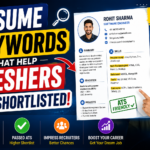
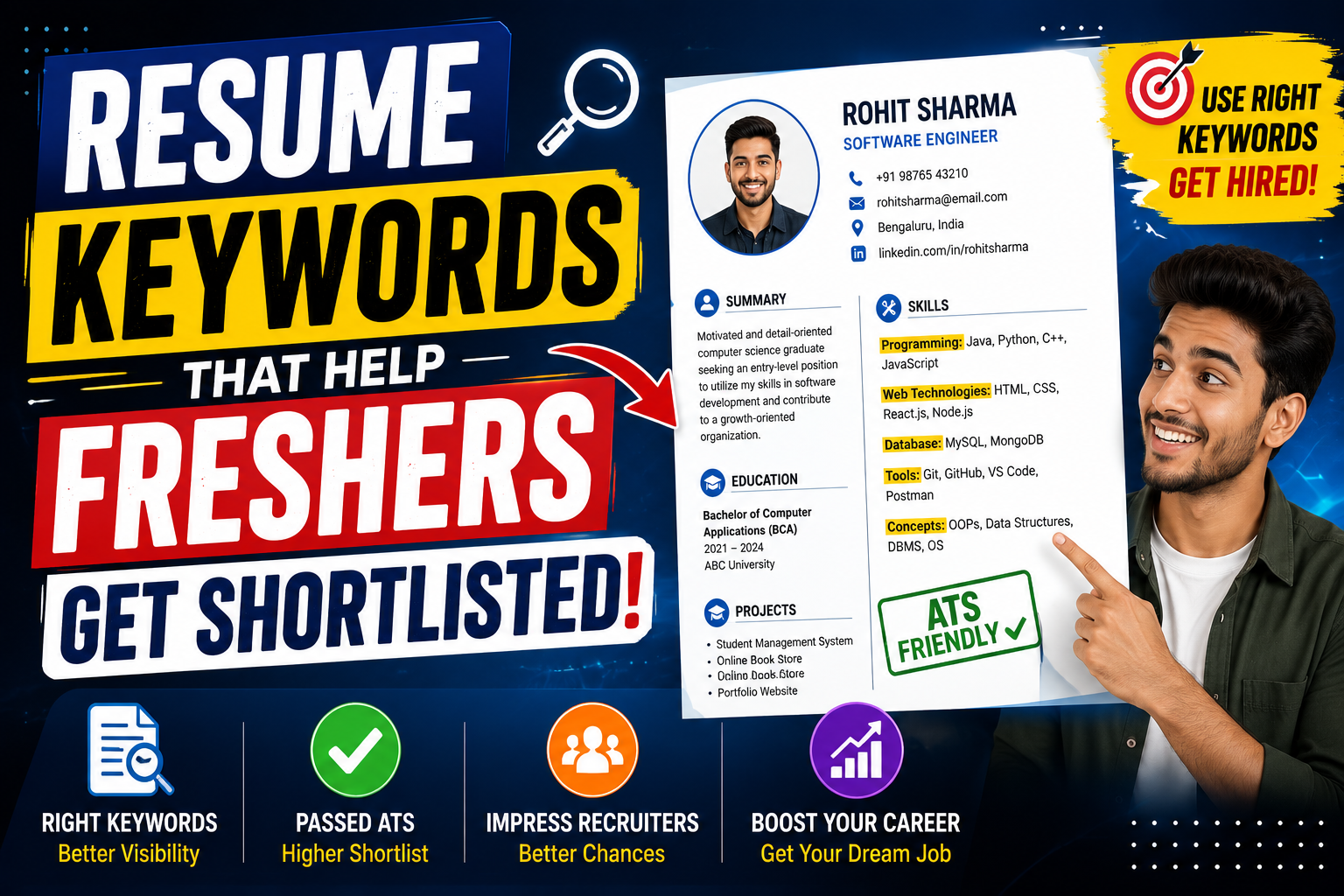
- Programming Languages: Java, Python, C, C++, JavaScript, TypeScript, SQL
- Core Concepts: Object-Oriented Programming (OOPs), Data Structures & Algorithms (DSA), System Design, Database Management Systems (DBMS), Operating Systems
- Frameworks & Libraries: React.js, Node.js, Spring Boot, Django, Flask, Express.js
- Development & Tools: Git, GitHub, REST APIs, JSON, Docker, Linux/Unix Command Line, VS Code
- Testing & Debugging: Unit Testing, JUnit, Postman, Debugging, Test-Driven Development (TDD)
For Data & Business Analysts
- Data Handling: SQL Queries, Data Cleaning, Data Visualization, Data Mining, ETL Processes
- Tools & Software: Power BI, Tableau, Advanced Excel (VLOOKUP, Pivot Tables), Google Sheets, Python (Pandas, NumPy, Matplotlib)
- Statistical Concepts: Descriptive Statistics, Regression Analysis, A/B Testing, Predictive Modeling
For Digital Marketing & Content Roles
- Marketing Concepts: Search Engine Optimization (SEO), Content Strategy, Copywriting, On-Page SEO, Keyword Research
- Platforms: Google Analytics, Google Search Console, WordPress, Meta Ads Manager, Mailchimp
Core Soft Skills Keywords
- Critical Thinking & Analytical Mindset
- Cross-Functional Collaboration
- Agile Mindset & Adaptability
- Written and Verbal Communication
- Time Management & Prioritization
High-Impact Action Verbs
- Instead of “Helped with”: Collaborated, Facilitated, Assisted, Supported, Partnered
- Instead of “Fixed”: Resolved, Optimized, Debugged, Refactored, Enhanced
- Instead of “Made”: Designed, Created, Configured, Established, Formulated
6. How ATS Keyword Scanning Works
The mechanics behind ATS software are straightforward:
[Job Description]  ---> (Extracts Key Terms: "Java", "SQL", "Git")
                              |
                              v
[Candidate Resume] ---> (Parses Text & Matches Exact/Synonym Keywords)
                              |
                              v
                      [Candidate Match Score]
                              |
               +--------------+--------------+
               |                             |
      (Score >= Threshold)          (Score < Threshold)
               |                             |
               v                             v
   Sent to Human Recruiter          Automated Rejection
- Parsing: The system converts your uploaded file into plain text, stripping out styling, images, and tables.
- Indexing: It identifies skills, section titles, educational background, and contact details.
- Scoring: The system calculates a match percentage based on how many times and how contextually your resume matches the job description.
- Ranking: Candidates with the highest match scores appear at the top of the recruiter’s dashboard.
8. Step-by-Step Guide to Keyword-Optimizing Your Resume
Follow this actionable, step-by-step process every time you apply for a job.
Step 1: Collect 3-5 Relevant Job Descriptions
Do not customize your resume based on a single posting. Gather three to five job descriptions for the exact role you are targeting (e.g., Junior Java Developer or Fresher Data Analyst).
Step 2: Highlight Frequently Used Terms
Read through the job descriptions and identify recurring terms. Pay close attention to sections titled “Requirements,” “Qualifications,” and “Responsibilities.”
Step 3: Match Keywords Against Your Real Skills
List the extracted terms and compare them against your actual knowledge, college projects, certifications, and internships.
Step 4: Integrate Keywords Naturally
Scatter these keywords throughout your resume sections:
- Professional Summary: 2-3 high-level core competencies.
- Skills Section: Grouped clearly into category lists.
- Projects / Experience: Embedded directly into bullet points using strong action verbs.
Step 5: Format for ATS Readability
- Save your resume as a clean PDF or standard DOCX file.
- Stick to standard section headers like
Work Experience,Projects,Skills, andEducation. - Avoid complex tables, multi-column templates, embedded graphics, or text boxes.
9. Benefits of Using Targeted Resume Keywords
- Higher Callback Rates: Passes initial automated screens, landing your application directly in front of hiring managers.
- Clarity and Precision: Removes vague descriptions and gives clear signals about what you know.
- Tailored Alignment: Shows recruiters that you actually read the job posting instead of sending out bulk applications.
- Levels the Playing Field: Helps freshers highlight technical coursework and practical projects effectively, offsetting a lack of formal job experience.
10. Limitations & Risks
While keywords are crucial, relying solely on them can backfire if done incorrectly.
- Keyword Stuffing Penalty: Simply dumping a list of 50 programming languages at the bottom of your resume makes it unreadable to humans and can trigger ATS spam filters.
- Interview Exposure: If you put “Docker” on your resume because it was in the job description, but you have never used it, an interviewer will quickly catch on.
11. Pros and Cons Comparison
| Aspect | Keyword-Optimized Resume | Traditional Generic Resume |
| ATS Pass Rate | High (Typically 70%+ match score) | Low (Often filtered out early) |
| Recruiter Impact | Immediate visual confirmation of required skills | Requires deep reading to find relevant details |
| Tailoring Effort | Requires 10–15 minutes per application type | Zero effort (One generic file sent everywhere) |
| Interview Conversion | High (When skills match real capabilities) | Low |
14. 5 Internal Linking Opportunities
If you are publishing this article on a career advice or tech portal, consider linking to these related guides:
- Anchor: “step-by-step guide on writing college project descriptions”Target URL:
/how-to-write-college-projects-on-resume - Anchor: “best ATS-friendly resume templates for developers”Target URL:
/ats-friendly-resume-templates-for-freshers - Anchor: “how to prepare for technical phone interviews”Target URL:
/fresher-technical-interview-preparation-guide - Anchor: “top entry-level software engineering skills in demand”Target URL:
/top-software-engineering-skills-freshers - Anchor: “how to optimize your LinkedIn profile as a fresher”Target URL:
/linkedin-profile-optimization-guide-freshers
15. 3 Authoritative External References
When citing data or best practices on ATS software and resume strategies, reference reputable industry sources:
- NACE (National Association of Colleges and Employers): For statistics regarding attributes employers seek on entry-level candidate resumes.
- Google Careers Guidance: For official documentation on using the “X-Y-Z” formula (Accomplished [X], as measured by [Y], by doing [Z]) in resume bullet points.
- LinkedIn Talent Solutions Reports: For data on emerging tech skills and hiring trends for entry-level professionals.
16. Frequently Asked Questions (FAQs)
1. How many keywords should I include in my resume?
Aim to include 10 to 15 core technical and action keywords that directly align with the specific job description. Focus on quality and context rather than cramming as many words as possible.
2. Can I get rejected by ATS if I use images or icons on my resume?
Yes. Many ATS parsers cannot read text embedded inside images, logos, or custom graphics. Stick to plain text formatting to ensure every word is indexed correctly.
3. Should I create a separate skills section or mix keywords into project descriptions?
You should do both. A dedicated Technical Skills section offers a quick scan for human recruiters, while including those same terms inside your Projects or Experience bullet points proves you know how to apply them.
4. Is it okay to list a programming language if I only learned it in one college semester?
Yes, as long as you understand the core concepts and can answer basic interview questions about it. List it under your skills, but prioritize the tools you have used in hands-on projects.
5. Does formatting as a PDF affect keyword recognition?
A standard PDF generated from Microsoft Word or Google Docs works well with modern ATS platforms. However, avoid uploading PDFs created via image design software (like Adobe Photoshop) where text isn’t selectable.
6. What is the difference between hard skill keywords and soft skill keywords?
Hard skill keywords refer to measurable technical abilities, tools, and certifications (e.g., Python, SQL, Data Warehousing). Soft skill keywords represent interpersonal qualities (e.g., Collaboration, Problem-Solving).
7. How do I know if my resume is ATS-compliant?
You can test your resume by opening the file, pressing Ctrl+A (or Cmd+A), and copying the text into a plain text editor like Notepad. If the text pastes cleanly in logical order without missing sections, an ATS will read it without issues.
8. Is keyword stuffing penalized by recruiters?
Yes. If an applicant pastes white text or dumps endless lists of irrelevant skills just to match an ATS, the human recruiter will immediately dismiss the application once they open it.
9. Should freshers customize their resume for every single job application?
It is best practice to customize your resume for distinct roles. However, instead of rewriting it every time, create 2–3 core versions (e.g., one tailored for Backend Engineering, one for Data Analytics, and one for Web Development).
10. Which resume file format is best for ATS parsing?
A simple, single-column .docx or a clean, text-based .pdf file is ideal. Unless specified otherwise by the employer, standard PDFs are preferred because they preserve formatting across devices.
17. Final Thoughts
Mastering resume keywords that help freshers get shortlisted isn’t about gaming the system—it is about clearly communicating your actual potential in a language that both automated systems and hiring managers understand.
Who Should Use This Keyword Strategy?
- Recent graduates seeking their first full-time role or internship.
- Freshers applying for positions through online portals, company career sites, or job boards.
- Early-career candidates transitioning into tech from non-traditional backgrounds.
Who Should Skip Heavy Optimization?
- Candidates applying through direct personal referrals where a hiring manager reviews the resume directly (though clear formatting still helps).
- Senior professionals with long track records whose experience speaks for itself through named company positions and metrics.
By taking a few extra minutes to analyze job postings, identify core technical terms, and naturally weave action verbs into your project descriptions, you can turn a ignored resume into a steady stream of interview calls.