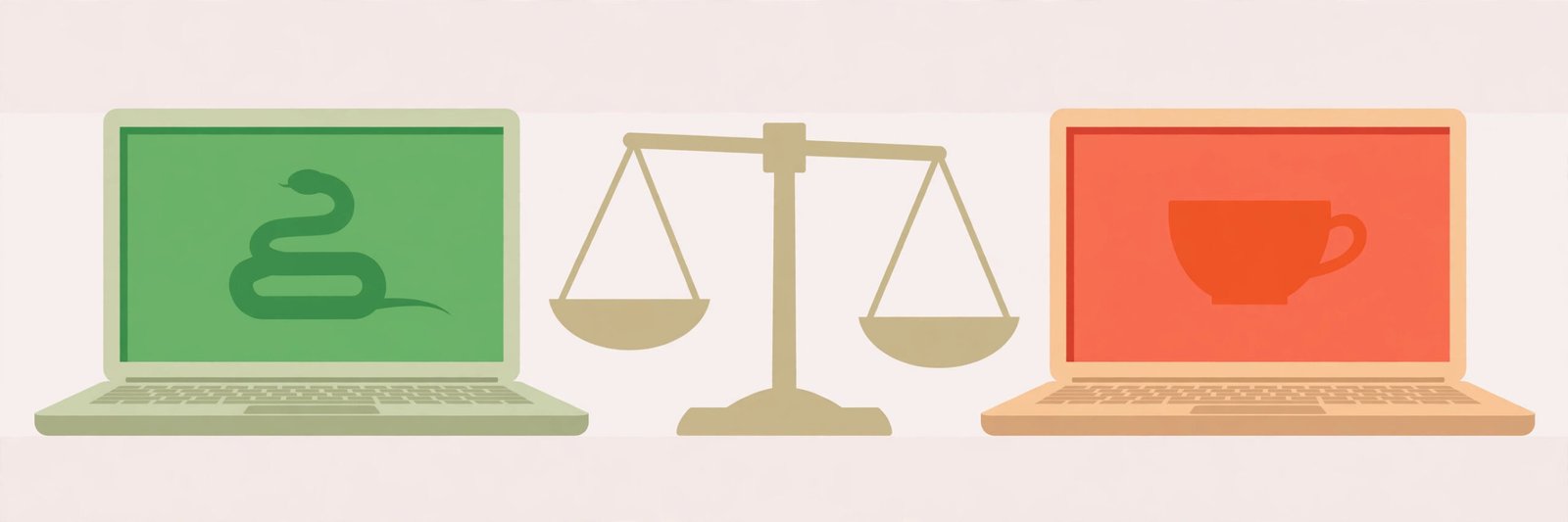
The python vs java for freshers debate is common because both languages are useful, popular and beginner-accessible in different ways. Python feels simple and friendly. Java feels structured and professional. Freshers often worry that choosing the “wrong” one will damage their career, but that fear is exaggerated. Your first language is mainly a tool for learning logic, problem solving and programming discipline. Both Python and Java can take you there.
The better question is: which language matches your current goal? If you want quick confidence, automation, data work or an easier start, Python may suit you. If you want strong object-oriented foundations, backend development or placement preparation, Java may suit you.
Quick verdict
Choose Python first if you are completely new to coding, dislike heavy syntax, or want to explore data, scripting and AI-related basics. Choose Java first if you want a more disciplined route into object-oriented programming, backend systems and interviews where Java concepts are commonly discussed.
If you are still confused after reading this guide, pick the language used in your college course or placement training. Familiar teaching support matters, and a language learned with guidance and daily practice beats a theoretically perfect language learned inconsistently. Keep this in mind throughout the python vs java for freshers comparison.
Python vs Java for freshers: the main differences
Syntax and first-week experience
Python code is shorter and closer to everyday English. You can print output, use variables and write loops with very little setup. This makes the first week encouraging. Java needs a class structure, a main method and more explicit declarations before the program becomes interesting. That can feel slow at the beginning, but it teaches how a complete program is organised.
For a fresher with low confidence, Python reduces friction. For a fresher who likes rules and structure, Java can feel satisfying once the pattern clicks.
Typing and program discipline
Python uses dynamic typing, which means you usually do not declare the type of a variable in advance. This is convenient, but it can also allow type-related surprises if you are careless. Java uses static typing in most beginner programs, so you declare types such as int, String or boolean, and the compiler catches some mistakes early. The strictness can feel demanding, yet it builds careful habits.
Object-oriented programming
Both languages support object-oriented programming, but Java pushes you into it from the start. Classes, objects, inheritance, interfaces and encapsulation are central to Java learning. Python also supports classes and objects, but you can write useful Python programs before learning OOP deeply. If your interview preparation includes detailed OOP questions, Java gives you a natural practice ground. If you want to delay OOP until your logic is stronger, Python is gentler.
Data structures and placement practice
For DSA, both languages work. Python solutions are usually shorter, so you can focus on the algorithm and finish code quickly. Java solutions are more verbose, but Java offers a strong collections framework and clear structures for stacks, queues, maps and sets. In interviews, the bigger factor is whether you can explain time complexity, choose the right data structure and write correct code. The python vs java for freshers choice should not be based only on DSA fear.
Projects and job-role direction
Python is a natural fit for automation scripts, data cleaning, simple APIs, beginner data projects and later paths such as data analysis or machine learning. Java is a natural fit for backend applications, enterprise-style projects, Android foundations and systems where structure and long-term maintenance matter.
Think about the projects you would enjoy building. A fresher who likes data and experiments may stay motivated with Python. A fresher who likes building structured applications may stay motivated with Java. Motivation matters in the python vs java for freshers decision more than most students admit.
Side-by-side comparison
| Point | Python | Java |
|---|---|---|
| Learning start | Easier and faster to read | Slower start, more structure |
| Syntax | Short and flexible | Longer and stricter |
| OOP learning | Can be learned gradually | Central from the beginning |
| DSA practice | Quick to code | Detailed and disciplined |
| Popular beginner paths | Data, automation, scripting, AI basics | Backend, enterprise apps, Android basics |
| Error checking | Many errors appear at runtime | Compiler catches many errors early |
| Best for | Fast confidence and experimentation | Strong foundations and structured apps |
This comparison shows why there is no universal winner. Python wins on comfort. Java wins on enforced structure. Your goal decides which advantage matters more.
A simple decision method for freshers
Answer these four questions honestly:
- Am I scared of coding right now? If yes, begin with Python and build confidence.
- Is my placement training based on Java? If yes, learn Java properly instead of fighting the syllabus.
- What projects excite me? Data and automation point to Python; backend and app-style structure point to Java.
- Can I practise for ninety days? Pick the language you can stay with for ninety days without switching.
This method works better than asking ten people and collecting ten opinions. In the python vs java for freshers discussion, consistency is the hidden deciding factor.
What a first month looks like in each language
If you choose Python
Week 1: print statements, variables, input, conditions and loops. Week 2: lists, tuples, dictionaries, sets and strings. Week 3: functions, file handling and error basics. Week 4: small projects such as a marks analyser, expense tracker or simple data-cleaning script. After that, begin DSA and OOP together.
If you choose Java
Week 1: program structure, variables, input, conditions and loops. Week 2: arrays, strings and methods. Week 3: classes, objects, constructors and inheritance basics. Week 4: collections and a console project such as a student management or library record system. After that, deepen OOP and DSA practice.
Notice that the topics are similar. Only the flavour changes. That is why switching later is not a disaster.
Common mistakes in the python vs java for freshers debate
The first mistake is believing one language guarantees a job. It does not. Interviews test problem solving, communication, projects and fundamentals. The second mistake is learning both at the same time from day one. Your brain keeps mixing syntax, and neither language becomes strong. The third mistake is choosing Java only because it sounds serious or Python only because it sounds easy. Both are professional languages when used well.
Another mistake is ignoring SQL, aptitude and communication while arguing about programming languages. Placements are a package. A fresher with one strong language, basic SQL, a decent project and clear communication is better prepared than a fresher who has touched six tools and mastered none.
FAQs
Which is easier in the python vs java for freshers comparison?
Python is easier at the start because the syntax is shorter and more readable. Java takes more time initially but teaches structure and discipline.
Is Java better than Python for campus placements?
Java may be better if your placement process and OOP preparation are Java-focused. Python may be better if you need faster coding and your target process allows any language. Check your college and company pattern if available.
Can I switch from Python to Java later?
Yes. Core concepts such as loops, functions, arrays and problem solving transfer well. You will mainly need to learn Java syntax, typing rules, OOP style and collections.
Should I learn Python if I want backend development?
Yes, Python can be used for backend development. Java is also strong for backend roles. Choose based on the framework and job direction you want to explore after the basics.
How do I finally decide between python vs java for freshers?
Pick the language connected to your immediate goal and support system, then commit for ninety days. Review your decision only after you have built basics and one project.
Conclusion
The python vs java for freshers question has no single correct answer, and that is good news. Python gives you speed, comfort and a friendly entry into coding. Java gives you structure, discipline and strong object-oriented foundations. Both can lead to interviews, projects and software roles when learned seriously. Stop waiting for a perfect verdict. Choose one, practise daily, build something real and let your skills make the next decision easier. That is the honest answer to python vs java for freshers.