What Is an ATS Friendly Resume Template?
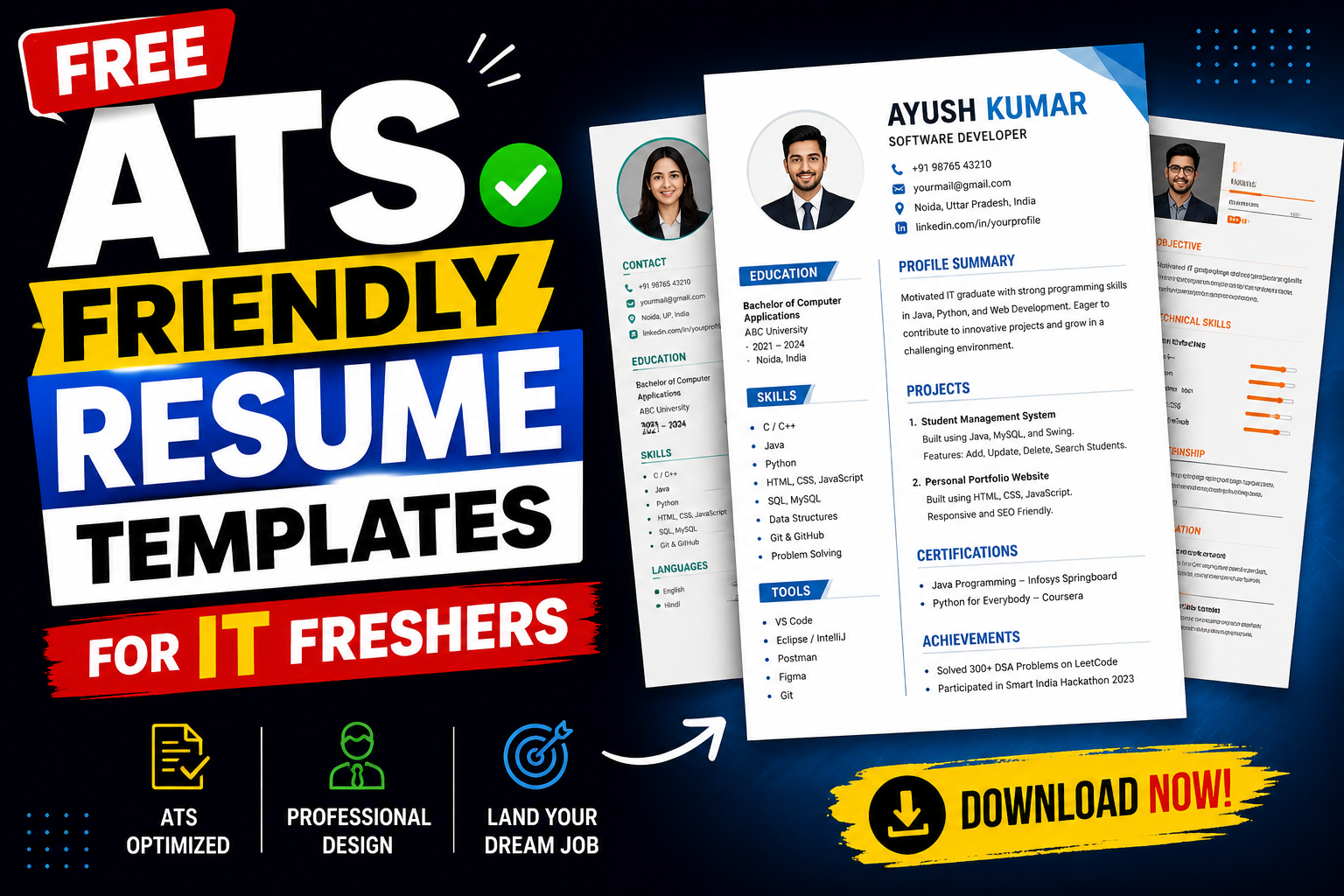
An ATS friendly template is a highly structured, single-column document layout designed to be easily read by recruitment software.
When large tech companies receive thousands of applications for a single entry-level role, recruiters use software to parse the documents, convert them into plain text, and search for specific keywords like “Java,” “React,” or “SQL.”
[Your PDF/Word Resume] ➔ [ATS Parser Software] ➔ [Plain Text Data Profile] ➔ [Recruiter Search Filter]
If the parser cannot extract the text properly due to complex formatting, your profile will appear blank or corrupted in the recruiter’s database. A proper technical template prioritizes clear text layout over complex visual design.
- What Is an ATS Friendly Resume Template?
- Why IT Freshers Must Use Plain Templates
- Key Features of a Successful Tech Resume
- How the Screening Process Works
- Scenario A: The Computer Science Graduate
- Scenario B: The Self-Taught Developer or Bootcamp Graduate
- Step-by-Step Guide to Customizing Your Template
- Limitations of Automated Templates
- Where to Find Genuine Free Templates
- 1. Can an ATS read a two-column resume?
- 2. Should I include my photo on a tech resume?
- 3. Is PDF or Word better for applicant tracking systems?
- 4. How long should a fresher’s resume be?
- 5. Should I list every programming language I learned in college?
- 6. What should I do if I have no work experience?
- 7. Can I use color in my resume?
- 8. How do I match my resume to a job description?
- 9. Do ratings or progress bars work for skills?
Why IT Freshers Must Use Plain Templates
Many college graduates use highly visual resume builders that feature colorful skill bars, side-by-side columns, and profile pictures. While these look visually striking to the eye, they fail technical screening processes completely.
❌ Bad Layout: Two columns, skill progress bars, icon graphics, text boxes.
   (The software reads text out of order, blending unrelated sentences together).

   Good Layout: Single column, clear text headers, standard bullet points.
   (The software reads top-to-bottom, left-to-right, capturing every keyword).
A common issue occurs with skill bars. If you use a graphic that shows “Python: 4 out of 5 stars,” the software cannot read the graphic. It simply sees the word “Python” without context, or misses it entirely. A text-based list reading “Languages: Python, Java, C++” ensures the system logs your skills correctly.
Key Features of a Successful Tech Resume
To ensure your application passes automated filters and holds a recruiter’s attention, it needs specific technical characteristics:
- Single-Column Layout: The text must flow naturally from top to bottom. Side columns confuse parsing algorithms.
- Standard Section Headings: Use simple labels like “Education,” “Technical Skills,” “Projects,” and “Experience.” Do not use creative titles like “Where I’ve Been” or “My Coding Journey.”
- Standard Web Fonts: Stick to clear typography like Arial, Calibri, Times New Roman, or Georgia.
- Bullet Points: Use standard round dots. Avoid custom icons, checkboxes, or arrow graphics.
How the Screening Process Works
When you submit your application, the software performs three main steps:
- File Conversion: The system strips away the styling and converts the document into a plain text file.
- Keyword Matching: The software checks this text against the job description requirements. If the job description asks for “REST APIs” and “Git,” the system looks for those exact phrases.
- Ranking: The platform scores your profile based on keyword frequency and relevance, presenting the highest-scoring applications to the hiring manager.
Practical Scenarios for Freshers
Let’s look at how different technical profiles should organize their documents.
Scenario A: The Computer Science Graduate
If you hold a B.Tech, BCA, or MCA degree, your education provides immediate context. Place your education section near the top, followed quickly by your academic or personal programming projects.
Scenario B: The Self-Taught Developer or Bootcamp Graduate
If your degree is in an unrelated field, place your “Technical Skills” and “Projects” sections at the very top. Lead with your live project URLs and GitHub links to prove your capabilities immediately.
Step-by-Step Guide to Customizing Your Template
Step 1: Download a Verified Template
Start with a blank Google Doc or Microsoft Word document using a clean, single-column format. You can use the free minimalist templates provided in the Google Docs template gallery (such as the “Spearmint” or “Serif” layouts with the columns removed).
Step 2: Configure Your Contact Information
Keep your header simple. Do not include your full home address—city and state are sufficient. Include your phone number, email address, LinkedIn URL, and GitHub profile link.
First Last Name
City, State | Phone Number | Email Address
LinkedIn URL | GitHub URL
Step 3: Write a Focused Technical Skills Section
Group your competencies by category so recruiters can scan them quickly.
- Languages: Java, Python, JavaScript, SQL
- Frameworks & Libraries: React.js, Node.js, Bootstrap
- Tools & Databases: Git, GitHub, MySQL, MongoDB
Step 4: Detail Your Projects with the STAR Method
Since you lack extensive industry experience, your projects act as your proof of work. Describe them using the Situation, Task, Action, and Result (STAR) framework.
[Project Title] | Technologies Used: React, Node.js, MongoDB
• Designed and deployed a full-stack e-commerce application handling user authentication and payment integration.
• Optimized database queries to reduce API response times by 15%.
• Managed source code using Git and deployed the final application on Vercel.
Step 5: Save in the Correct Format
Unless the application portal specifically requests a Word document (.docx), export your final document as a PDF. Modern parsing engines read PDFs easily, and the format ensures your layout looks identical on every screen.
Benefits of Using Optimized Layouts
- Higher Match Scores: Your skills map accurately to job descriptions, increasing the likelihood of passing initial automated reviews.
- Faster Human Review: Technical recruiters spend an average of six seconds scanning a profile. A clean layout ensures they see your programming languages instantly.
- Consistent Formatting: PDFs preserve your margins and fonts perfectly across different operating systems.
Limitations of Automated Templates
While an optimized layout ensures the software reads your text, it cannot fix weak content. If your document lacks relevant keywords or fails to demonstrate project work, passing the automated screen will not lead to an interview invitation.
Additionally, these layouts can look plain or sparse compared to heavily styled graphic designs. However, in the technical industry, clarity and content always outrank decorative borders.
Pros and Cons of Single-Column Systems
| Advantages | Disadvantages |
| Guaranteed readability by software parsers | Can look visually plain or unexciting |
| Easy to edit, update, and customize quickly | Harder to condense past two pages if you have extensive content |
| Works perfectly across all major job portals | Limited space for creative personal expressions |
| Focuses attention entirely on your technical skills |
Where to Find Genuine Free Templates
- Google Docs: Open Google Docs, visit the Template Gallery, and look for the “Standard Resume” or “Modern Writer” layouts. Remove any default decorative elements before exporting.
- Deedy Resume (LaTeX): For those comfortable with LaTeX, the Deedy template is a popular, highly structured choice favored by computer science graduates.
Common Mistakes Users Make
- Using Images for Text: Never take a screenshot of your skills list or certificates and paste it into the document. Software cannot read text embedded inside images.
- Putting Text inside Tables: Some tracking systems read tables out of order, reading column one row one, then column two row one, which scrambles your sentences.
- Spelling Technical Terms Incorrectly: If you write “Javscript” instead of “JavaScript,” the software will miss the keyword entirely. Double-check all technical spelling.
Frequently Asked Questions
1. Can an ATS read a two-column resume?
Some modern tracking systems can read two columns, but older systems often read straight across the page, combining the first line of column one with the first line of column two. A single-column layout is the safest choice to ensure compatibility across all systems.
2. Should I include my photo on a tech resume?
No. Most tracking systems cannot process image files properly, and many companies reject resumes with photos immediately to comply with anti-discrimination policies.
3. Is PDF or Word better for applicant tracking systems?
Both formats work well with modern systems, but PDF is generally preferred because it preserves your formatting exactly as intended when viewed by human recruiters.
4. How long should a fresher’s resume be?
It should fit neatly on one page. Recruiters review entry-level profiles quickly, so keep your descriptions concise and impactful.
5. Should I list every programming language I learned in college?
Only list languages you understand well enough to discuss in a technical interview. Listing a language you only used for a single assignment can create issues if you are tested on it later.
6. What should I do if I have no work experience?
Focus heavily on your personal coding projects, academic assignments, open-source contributions, and technical certifications.
7. Can I use color in my resume?
Yes, you can use subtle accent colors like dark blue or gray for section headers, but keep the body text black for clear readability.
8. How do I match my resume to a job description?
Review the job posting for recurring technical skills and phrases. If the description emphasizes “database management,” ensure that exact phrase appears in your skills or projects section.
9. Do ratings or progress bars work for skills?
No. Tracking systems cannot interpret graphic sliders or star ratings, and human recruiters often find self-assessed star ratings subjective and uninformative.
10. Should I include my soft skills in the skills section?
It is more effective to demonstrate soft skills through your project descriptions (e.g., “collaborated with a team of three to build…”) rather than listing words like “communication” or “teamwork” in a standalone list.
Final Thoughts
If you want to maximize your chances of securing entry-level tech interviews, opt for a clean, single-column text layout.
This approach is best for: Freshers applying to medium-to-large technology companies, engineering graduates, and anyone submitting applications through online job portals.
This approach is not required for: Designers or frontend developers handing a physical portfolio directly to a creative director at a networking event or small boutique agency where human eyes review every application first.
Prioritizing clean, well-organized text ensures that tracking systems can parse your qualifications accurately, helping your technical skills reach the hiring manager cleanly.