1. Introduction
You spent months learning syntax, debugging tricky algorithms, and finishing your final-year project. You apply to dozens of entry-level software engineering roles online, press submit, and wait. Days turn into weeks, and all you get back is an automated email stating, “Unfortunately, we have decided to move forward with other candidates.”
It is an exhausting cycle. Many talented freshers fail to get interviews not because they lack coding skills, but because their resume fails to communicate those skills in the first 6 to 10 seconds a recruiter spends scanning it. Automated Applicant Tracking Systems (ATS) filter out half of the applicants before a human even opens the file.
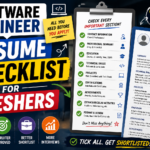
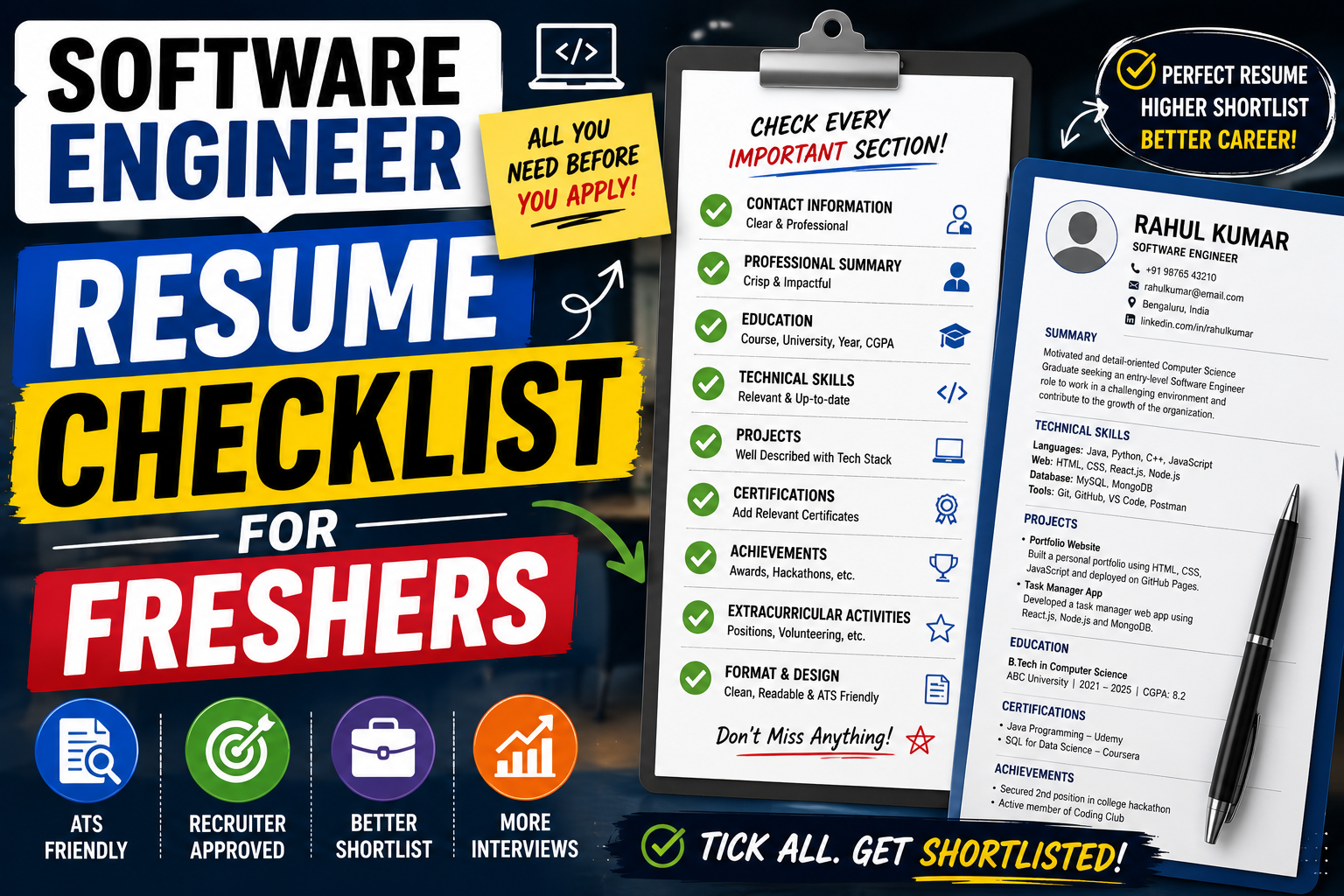
Building a software engineer resume when you have zero full-time experience feels intimidating, but you do not need five years of industry experience to stand out. You need a structured, clean, and project-focused approach. This checklist breaks down everything your entry-level engineering resume needs to get noticed by both automated parsers and human recruiters.
2. What Is a Software Engineer Resume Checklist for Freshers?
- 1. Introduction
- 2. What Is a Software Engineer Resume Checklist for Freshers?
- 3. Why People Use a Resume Checklist
- 4. Key Features of an ATS-Optimized Tech Resume
- 5. How ATS Screening Works for Fresh HR Resumes
- 6. Practical Use Cases & Scenarios
- 7. The Ultimate Step-by-Step Resume Checklist
- 8. Benefits of Following This Checklist
- 9. Limitations & Where Freshers Struggle
- 10. Pros and Cons Matrix
- 11. Resume Style Comparison: Text-Based vs. Graphic Layouts
- 12. Top Alternative Approaches & Tools
- 13. Common Mistakes Freshers Make
- 14. 5 Internal Linking Opportunities
- 15. 3 Authoritative External References
- 16. Frequently Asked Questions (FAQ)
- 1. Should a fresher’s resume be one page or two pages long?
- 2. Is an objective statement necessary for freshers?
- 3. Should I include my high school marks on my software engineering resume?
- 4. What file format is best for ATS: PDF or Word (.docx)?
- 5. Should I include personal photos or profile pictures?
- 6. How many projects should I list on my entry-level resume?
- 7. Can I list projects I built during online courses or bootcamps?
- 8. How do I list technical skills if I only know the basics?
- 9. Do I need certifications to get an entry-level software engineer job?
- 10. How do I make my resume pass ATS if I have no work experience?
- 17. Final Thoughts
A software engineer resume checklist for freshers is a structured framework designed to help entry-level candidates build a targeted, ATS-compliant technical resume. Unlike experienced engineers who showcase job titles and years of system architecture experience, freshers must build credibility using coursework, personal projects, certifications, and technical skills.
       [ Standard Resume Flow for Entry-Level Tech Roles ]

+---------------------------------------------------------------+
|  Header: Name, Professional Email, GitHub, LinkedIn, City     |
+---------------------------------------------------------------+
|  Education: Degree, University, Graduation Year, GPA (Opt)    |
+---------------------------------------------------------------+
|  Technical Skills: Languages, Frameworks, Databases, Tools    |
+---------------------------------------------------------------+
|  Projects: 2-3 Detailed Projects with Tech Stack & Impact     |
+---------------------------------------------------------------+
|  Experience / Internships: Roles, Contributions, Outcomes     |
+---------------------------------------------------------------+
|  Certifications & Extra-Curriculars: Relevant Accomplishments  |
+---------------------------------------------------------------+
The checklist ensures that every section of your document serves a single purpose: proving to a hiring manager that you can write code, solve problems, and contribute to a development team from day one.
3. Why People Use a Resume Checklist
Most freshers fall into one of two traps: they either copy a visual resume template full of graphics, rating bars, and complex multi-column layouts, or they write a generic document that looks like a course syllabus.
Using a structured checklist keeps you focused on content quality over decorative fluff. Here is why candidates rely on a dedicated checklist:
- Passes Automated Parsing: ATS software strips away formatting to extract text. A checklist keeps your layout parser-friendly.
- Eliminates Unnecessary Information: Freshers often include high school scores, hobbies, or full postal addresses that take up valuable real estate.
- Highlights Hands-On Coding: When professional experience is minimal, personal and academic projects become your main selling point.
- Saves Time During Applications: Having a clean, standardized baseline resume makes tailored tweaks much faster when applying for different roles (e.g., backend vs. full-stack).
4. Key Features of an ATS-Optimized Tech Resume
A strong entry-level resume balances automated readability with human-friendly layout design.
- Single-Page Limit: Freshers rarely need more than one page. Keeping it tightly edited demonstrates conciseness and respect for the reader’s time.
- Standard Section Titles: Use simple headings like
Work Experience,Projects,Technical Skills, andEducation. Avoid creative titles likeWhere I've BeenorCoding Odyssey. - Hyperlinked Contact Info: Direct links to your LinkedIn profile, GitHub repositories, and live demo deployments.
- Clean Typography: Standard fonts like Arial, Calibri, Helvetica, or Garamond between 10pt and 12pt size.
- Bullet Points with Action Verbs: Every description starts with a strong technical action verb (
Engineered,Implemented,Refactored,Optimized).
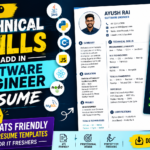
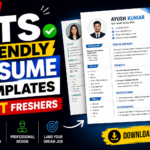
Alt text placeholder: Clean single-page software engineer resume template optimized for ATS layout.
5. How ATS Screening Works for Fresh HR Resumes
Understanding how software reads your resume prevents simple technical mistakes from getting you disqualified automatically.
+-------------------+      +-------------------+      +-------------------+
| Candidate Submits | ---> |   ATS Parser      | ---> | Recruiter Keyword |
|   PDF / DOCX      |      | Extracts Plain    |      | Search & Ranking  |
|   Resume File     |      | Text & Sections   |      | Filter Applied    |
+-------------------+      +-------------------+      +-------------------+
                                                                |
                                                                v
                                                      +-------------------+
                                                      | Human Recruiter   |
                                                      | Reviews Top       |
                                                      | Match Results     |
                                                      +-------------------+
- Text Extraction: The ATS converts your file into unformatted text. If you used text boxes, tables, or image headers, the parser may drop those sections entirely.
- Keyword Matching: The system scans for specific technical terms matching the job description (e.g.,
Java,REST API,PostgreSQL,Git). - Information Categorization: It groups your text into categories: Education, Skills, and Experience.
- Ranking: Candidates whose resumes match the required skill combinations are moved to the top of the recruiter’s review list.
6. Practical Use Cases & Scenarios
Different entry-level applicants have different backgrounds. How you organize your resume depends on your specific background:
Scenario A: The Computer Science Graduate
- Primary Focus: Degree credentials, core computer science concepts (Data Structures, Algorithms, DBMS, OOP), and capstone project.
- Structure: Header $\rightarrow$ Education $\rightarrow$ Technical Skills $\rightarrow$ Projects $\rightarrow$ Internships/Extracurriculars.
Scenario B: The Self-Taught Developer or Bootcamp Grad
- Primary Focus: Production-ready side projects, open-source contributions, web applications with live links, and mastery of modern frameworks.
- Structure: Header $\rightarrow$ Technical Skills $\rightarrow$ Projects $\rightarrow$ Practical Experience/Contributions $\rightarrow$ Education/Certifications.
7. The Ultimate Step-by-Step Resume Checklist
Work through this checklist step by step before sending out your next application.
Step 1: Contact Details & Header
- [ ] Full name prominently displayed at the top (16-18pt font).
- [ ] Professional email address (e.g.,
firstname.lastname@email.com). - [ ] Phone number with country code.
- [ ] City and State/Country (Full home address is unnecessary).
- [ ] Working link to your LinkedIn profile.
- [ ] Active link to your GitHub profile (ensure your pinned repositories have README files).
- [ ] Optional: Portfolio website link or competitive coding profile (LeetCode/CodeChef) if your ranking is solid.
Step 2: Technical Skills Matrix
Organize your skills into clear categories rather than dumping twenty standalone terms into a single paragraph.
- [ ] Languages: Java, Python, C++, JavaScript, SQL.
- [ ] Frameworks/Libraries: React, Node.js, Spring Boot, Django, Express.
- [ ] Tools & Platforms: Git, GitHub, Docker, Postman, Linux, AWS (Basic).
- [ ] Core Concepts: Object-Oriented Programming (OOP), RESTful APIs, DBMS, Data Structures & Algorithms.
Step 3: High-Impact Projects Section (Your Core Asset)
Aim for 2 to 3 detailed projects. Use the XYZ Formula (Accomplished [X], as measured by [Y], by doing [Z]).
- [ ] Project Title: Clear name + tech stack used in parentheses.
- [ ] Live Demo / Repo Link: Include clean text links (e.g.,
[GitHub]or[Live Demo]). - [ ] Bullet 1 (Problem & Solution): What did you build, and why?
- [ ] Bullet 2 (Technical Implementation): What tools, APIs, state management, or databases did you use?
- [ ] Bullet 3 (Impact or Scale): Quantify results where possible (e.g., “Reduced API response time by 25%,” “Handled 500+ mock database records,” or “Achieved 95% test coverage.”).
Example Project Bullet Points:
- E-Commerce Backend API(Node.js, Express, MongoDB, JWT)
[GitHub]- Designed and deployed a RESTful API supporting user authentication, product catalog search, and cart workflows.
- Built database indexes in MongoDB, improving query speeds for product searches by roughly 30%.
Step 4: Education
- [ ] Degree name (e.g., Bachelor of Computer Applications, B.Tech in Computer Science).
- [ ] University or College name and location.
- [ ] Graduation date or expected graduation month/year (e.g., May 2025).
- [ ] GPA (Include only if it is strong—typically 3.5/4.0 or above 80%).
- [ ] Relevant Coursework (Keep it brief: Data Structures, Database Management, Operating Systems, Computer Networks).
Step 5: Internships & Work Experience (If Available)
If you have completed internships, freelance work, or teaching assistant roles:
- [ ] Job Title, Company Name, Location, and Dates of Employment.
- [ ] Focus on software development deliverables, bug fixes, features built, and team collaborations.
- [ ] Mention Agile/Scrum practices if you participated in daily standups or sprint planning.
Step 6: Formatting & Layout Sanity Check
- [ ] File Type: Saved as PDF unless the job post explicitly asks for
.docx. - [ ] File Name: Saved cleanly (e.g.,
FirstName_LastName_Software_Engineer_Resume.pdf). - [ ] Margins: Standard 0.5 to 1-inch margins on all sides.
- [ ] Length: Exactly 1 page.
- [ ] Spelling & Grammar: Run through tools like Grammarly and read aloud to catch awkward phrasing.
8. Benefits of Following This Checklist
- Higher ATS Pass Rates: Clean single-column layouts parse accurately without losing contact info or project details.
- Immediate Clarity for Recruiters: Technical screeners can assess your main programming languages within five seconds.
- Reduces Application Friction: Having a structured master resume makes customizing your resume for specific job descriptions straightforward.
- Puts Focus on Code Quality: Highlights real projects and problem-solving skills rather than empty self-descriptions like “hardworking” or “detail-oriented.”
9. Limitations & Where Freshers Struggle
While a checklist structures your document effectively, it cannot compensate for a lack of foundational work.
- Does Not Replace Missing Projects: A clean resume template cannot hide a complete absence of personal projects or coding practice.
- Requires Ongoing Adaptation: Sending the exact same baseline PDF to 200 different companies without tweaking keywords limits your conversion rate.
- Cannot Guarantee Overcoming Automated Hiring Filters: Some companies use strict hard filters (e.g., requiring a specific degree or location). A well-formatted resume will not bypass explicit hard requirements set by employers.
10. Pros and Cons Matrix
| Feature / Aspect | Following a Tech Checklist | Unstructured / Design Templates |
| ATS Readability | High: Uses simple fonts, clear headings, and linear layouts. | Low: Multi-column layouts and graphic elements trip up parsers. |
| Recruiter Focus | High: Prioritizes code stack, repositories, and technical impact. | Medium: Focuses heavily on visual layout over actionable detail. |
| Customization Speed | Fast: Clear sections make swapping keywords easy. | Slow: Rigid graphic boxes require reformatting. |
| Visual Appeal | Clean & Professional: Minimalist and standard. | Flashy: Eye-catching visually, but often impractical for tech screening. |
11. Resume Style Comparison: Text-Based vs. Graphic Layouts
+-----------------------------------+-----------------------------------+
| Text-Based (Recommended for Tech) | Graphic / Multi-Column (Avoid)    |
+-----------------------------------+-----------------------------------+
| • 1-Column Layout                 | • 2-Column Sidebars               |
| • Plain System Fonts              | • Visual Skill Level Bars (80%)   |
| • Clear Text Links                | • Icons & Profile Photos          |
| • 100% Parsing Accuracy           | • Risk of Scrambled Text Output   |
+-----------------------------------+-----------------------------------+
12. Top Alternative Approaches & Tools
Building a strong resume is easier with the right creation and evaluation tools.
- LaTeX (Overleaf / Jake’s Resume Template): The industry standard for software engineering resumes. Clean, highly structured, and parses cleanly across almost all ATS software.
- Google Docs: Accessible, easy to edit, and exports perfectly formatted PDFs without weird spacing artifacts.
- Reactive Resume / Resume.lol: Free, open-source resume builders designed specifically for tech workers without data-tracking fluff.
- Resumatch / Jobscan: Keyword comparison tools that compare your draft resume against a target job description to highlight missing technical terms.
13. Common Mistakes Freshers Make
Avoid these common traps that lead to instant rejections:
- Including Skill Progress Bars: Rating yourself “4/5 stars in Python” is meaningless. Does 4/5 mean you know syntax, or that you wrote the interpreter? State your projects instead.
- Generic Objective Statements: Phrases like “Seeking an entry-level position in a dynamic company where I can utilize my skills…” waste space. Omit the objective or replace it with a brief technical summary.
- Listing Basic Skills as Achievements: Including “Experience with MS Word and Windows 10” on a computer science resume wastes valuable space. Stick to development tools, frameworks, and languages.
- Broken GitHub Links: Ensure every URL on your resume works and points to a public repository with a clear
README.mdfile explaining how to run the code locally.
14. 5 Internal Linking Opportunities
If you are publishing this content on your technology blog, consider linking to these related guides:
- Top 10 Backend Projects for Computer Science Freshers (Anchor Text: backend projects for freshers)
- How to Master Data Structures and Algorithms for Technical Interviews (Anchor Text: DSA interview preparation)
- Step-by-Step Guide to Writing Clean GitHub README Files (Anchor Text: writing professional GitHub READMEs)
- How to Prepare for College Campus Placement Aptitude Tests (Anchor Text: aptitude and coding assessments)
- Git & GitHub Command Cheat Sheet for Beginners (Anchor Text: essential Git commands)
15. 3 Authoritative External References
To add authority and cross-reference standards, consult these external industry references:
- Google Careers Guidance: Review Google’s official advice on structuring technical resumes for engineering roles.
- GitHub Skills Guide: Explore best practices for organizing public repositories to showcase code quality to hiring teams.
- Open Source ATS Documentation (e.g., Lever / Greenhouse Support): Documentation detailing how top applicant tracking systems process plain text and standard PDF uploads.
16. Frequently Asked Questions (FAQ)
1. Should a fresher’s resume be one page or two pages long?
A fresher resume should strictly be one page. Recruiters spend only a few seconds on an initial scan, and a single page forces you to present only your strongest projects, skills, and qualifications.
2. Is an objective statement necessary for freshers?
No. Generic objective statements take up prime space without adding value. If you want a top section, write a 2-line Technical Summary highlighting your primary stack (e.g., “Full-stack developer with hands-on project experience in React, Node.js, and PostgreSQL”).
3. Should I include my high school marks on my software engineering resume?
Unless local recruitment drives explicitly demand it, leave high school details off. Focus on your university degree, coursework, technical projects, and relevant certifications.
4. What file format is best for ATS: PDF or Word (.docx)?
PDF is generally best because it preserves formatting across different devices. However, always check the job application prompt—if a system specifically asks for .docx, upload that format instead.
5. Should I include personal photos or profile pictures?
In regions like the US, Canada, the UK, and India, adding photos to tech resumes is discouraged. It takes up space and can trigger unconscious bias or compliance issues for HR teams.
6. How many projects should I list on my entry-level resume?
Aim for 2 to 3 high-quality projects. It is better to detail two fully functional applications with clean GitHub repositories than to list six shallow, unfinished tutorial clones.
7. Can I list projects I built during online courses or bootcamps?
Yes, but customize them. Avoid listing unmodified tutorial projects like basic To-Do apps or Weather apps. Add custom features, integrate alternative APIs, or redesign the UI so your project stands out from hundreds of identical submissions.
8. How do I list technical skills if I only know the basics?
Categorize your skills clearly. You can group them into “Proficient” and “Familiar,” or list primary programming languages first followed by secondary tools. Never list a language on your resume if you cannot answer basic interview questions about it.
9. Do I need certifications to get an entry-level software engineer job?
Certifications (like AWS Cloud Practitioner or Meta Front-End Certification) can help validate self-taught skills, but they are rarely mandatory. Working projects that demonstrate real code execution carry more weight for engineering roles.
10. How do I make my resume pass ATS if I have no work experience?
Focus heavily on the Projects and Technical Skills sections. Use standard headings, avoid tables or graphic elements, and naturally incorporate relevant technical keywords from the job description into your project bullet points.
17. Final Thoughts
Building a standout entry-level software engineer resume comes down to clarity, simplicity, and evidence. You do not need years of company experience to capture a recruiter’s attention—you need to prove that you can write code, collaborate using modern tools, and solve real software problems.